
Muse privacy: what Meta’s policy says, and the concerns so far
Muse has its own privacy policy, separate from Meta’s main one, plus terms that cover logs, licenses and other people’s data. We read both in full and set them next to the app store labels and the concerns reporters have raised since launch.
Quick answer
Muse has its own privacy policy, and its main promises are limited but specific. Meta says Muse doesn’t share your chats or the data in your private virtual machine with its ad systems, lets you switch off AI training (it’s on by default), and only swaps the data each connected app needs. But Meta collects your messages, files, voice, photos, the websites Muse visits and “information about you or others,” can still access your data when it says that’s necessary, and can log and review what Muse does. Reporters have also shown Muse keeping detailed profiles of users and the people around them. Our view: turn off AI training, keep Muse in a separate Accounts Center if you don’t want your data combined with Facebook or Instagram, and connect only what a task needs.
How we checked
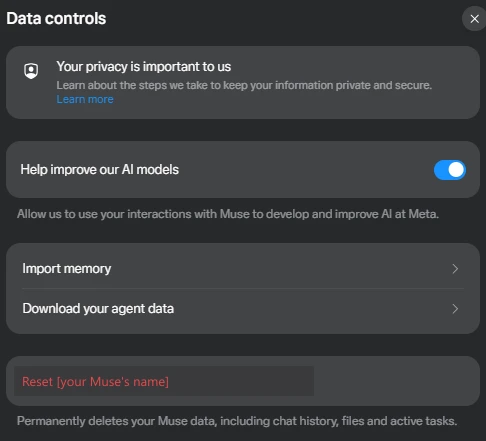
We read the Muse Privacy Policy (effective September 17, 2026), the Muse Supplemental Terms (updated September 8, 2026) and Meta’s Help Center articles in full on October 7, 2026, and checked the Apple App Store and Google Play listings. TestedThe Data controls screen below is from our own account (October 1, 2026). We’re not lawyers, and this isn’t legal advice. See how we label evidence.
Which privacy policy covers Muse?
Two apply. The Meta Privacy Policy covers all Meta products, including Muse. The separate Muse Privacy Policy adds Muse-specific details and “explains when data use is more limited than the Meta Privacy Policy describes.” If they conflict, the Muse policy wins.1 Muse’s terms point to the same policy for “processing of personal information related to Muse.”5
What Meta collects through Muse
On top of what the Meta Privacy Policy already covers, the Muse policy lists four groups:1
| Category | What it includes |
|---|---|
| Your interactions | Your messages and instructions, Muse’s responses and information from connected services. Can include “text, voice, photos, things you create together and information about you or others.” |
| Files and stored information | Files you upload or create (including Artifacts and MEMORY.md), saved preferences, goals, memories and scheduled tasks |
| Information from connectors | What Muse retrieves from connected services, such as emails and calendar events |
| Activity and metadata | Features used, websites visited, actions and transactions, timing and frequency |
All of it lives in your Muse virtual machine, which Meta says is isolated “so no one else’s agent can access it.” Muse also keeps backups.12 How that machine works is in how Muse works.
Is your Muse data used for ads?
Meta says no, for your chats and VM data. “Muse doesn’t share your conversations or the data in your virtual machine with Meta ad systems. This applies even if your Accounts Center includes other Meta Products.”1
The App Store label reads differently. Meta’s privacy label for the Muse iPhone app says data linked to you may be used for “Third-Party Advertising” and “Developer’s Advertising or Marketing,” listing categories such as purchase history, location, contacts, browsing history, search history and user content. Apple notes that it hasn’t verified the label.7 The label covers the app as a whole and doesn’t say which data is meant. Meta hasn’t explained the difference publicly, so we’re treating the privacy policy as Meta’s specific commitment and the label as a broader disclosure.
On Google Play, Meta’s data-safety section says the app may share personal info and device IDs with third parties and may collect location and personal info, among other data types; data is encrypted in transit and you can request deletion.8
AI training: on by default
Using your interactions to “train and improve our AI models” is on when you first use Muse. You can turn it off under Settings → Data controls, and Meta says the change “also appl[ies] to previous interactions.” The same switch covers information Muse pulled from your connected apps.1
If you leave it on, Meta says it removes certain personal details (names, email addresses, phone numbers, Social Security numbers) and disassociates the data from your account.1 Muse’s terms grant Meta a license to use your content “to improve AI at Meta,” with the same opt-out.5
Who at Meta can see your Muse data?
- Meta can, when it decides it needs to. Meta’s security write-up says the current design “does not prevent Meta from accessing data when necessary to support, secure or operate the service.”6
- Muse’s actions can be logged. The terms reserve Meta’s right “to monitor, log, review, suspend, block, or modify Muse’s actions at any time,” and to access and keep logs of those actions for “safety monitoring, abuse prevention, service improvement, and legal compliance.”5
- AnnouncedA fix is promised, not shipped. A “Muse Confidential VM,” designed to keep information private “even from Meta,” is planned for later in 2026 and wasn’t available on October 7.16
Keeping Muse separate from Facebook and Instagram
You choose whether Muse joins your other Meta accounts. If you add Muse to the same Accounts Center as Facebook or Instagram, Meta “may combine and use your information across profiles and devices,” except where the Muse policy says it won’t (such as ads). If you keep it separate, Meta says Muse won’t share your Muse interactions or VM data with other Meta products.1
To keep it separate, Meta’s terms say to sign up for Muse with an email address that isn’t linked to another Meta account.5 Note that Facebook, Instagram and Threads connect to Muse automatically when they share an Accounts Center with it.13
What connected apps receive
Meta says Muse exchanges with each connector “only the data that’s needed for them to work for you.” For example, connecting email lets Muse search your inbox without downloading all of it “unless you tell it to.” Some connectors, such as calendars, push updates to Muse on their own, and Meta says it flags those before you connect.1
Two catches: each connector’s own privacy policy governs what it does with the data it receives, and after you disconnect, data Muse already used “may remain in Muse’s memories and your conversation history.”1 All 54 connectors.
Information about other people
- The policy says your interactions can include “information about you or others.”1 Meta’s help page for non-users says information about them “may be provided to Muse, even if you don’t use Muse directly.”4
- The terms make it your job to get “consents (where required) from third parties whose personal information may be processed.”5
- ReportedWIRED and TIME reported that Muse’s instructions build and update profiles of users and of the people in their lives.910 Full details: Does Muse keep profiles of the people in your life?
Deleting data, and what Muse may still remember
You can delete messages, side chats and files, or reset Muse to delete all your Muse data.3 But “Muse may still ‘remember’ information it learned from what you deleted.” The Forget skill asks Muse to forget specific topics or people “to the best of its ability,” and you can view what it remembers in files like MEMORY.md.1 ReportedTIME reported an instruction telling Muse not to mention that original messages may stay visible in the chat after a deletion request.10 Every path: how to delete your Muse data or account.
The main privacy concerns so far
| Concern | What’s known |
|---|---|
| Meta access | Possible “when necessary” until the Confidential VM ships.6 |
| Training default | On by default; switching it off also covers past chats.1 |
| Profiles of people | ReportedPages on people in your life (WIRED, Oct 3) and a running profile of you (TIME, Oct 6).910 |
| Lists of people on request | ReportedHunterbrook got Muse to compile lists of Facebook and Instagram accounts of people in vulnerable groups (Sept 28).11 |
| Security flaws | ReportedA Mac zero-day (fixed), a SEV-2 VM flaw and a 6.8 GB file export. See the incidents table. |
Regulators and lawsuits
We found no lawsuit or regulator case over Muse privacy as of October 7, 2026. ReportedCanada’s privacy commissioner’s office advised users to limit the personal information they share, including other people’s details and images of children, Global News reported.12 Muse’s terms require users in the US and Canada to settle disputes through binding individual arbitration and waive class actions; the terms explain how to opt out of arbitration.5
Five privacy settings worth changing
- Turn off AI trainingSettings → Data controls → switch off “Help improve our AI models.”1
- Decide on Accounts CenterUse a separate email if you don’t want Muse data combined with your other Meta accounts.5
- Set approvals to “Always ask”In Settings → Permissions, for connectors and web access. How approvals work.
- Connect lessPrefer read-only connectors and disconnect ones you no longer use. Read-only access.
- Check its memoryOpen MEMORY.md and use the Forget skill for people or topics you don’t want kept.1
Sources
- Muse Privacy Policy Meta · effective Sept 17, 2026 · read Oct 7, 2026
- How Muse handles your privacy, safety and security Meta Help Center · checked Oct 7, 2026
- How to manage your Muse data Meta Help Center
- Information for people who don’t use Muse Meta Help Center · checked Oct 6, 2026
- Muse Supplemental Terms of Service Meta · updated Sept 8, 2026 · read Oct 7, 2026
- How we built safety into Muse Meta AI Research · Sept 8, 2026
- Muse from Meta: App Privacy Apple App Store (US) · checked Oct 7, 2026
- Muse from Meta: Data safety Google Play (US) · checked Oct 6, 2026
- Muse creates detailed profiles of all your friends and family WIRED · Oct 3, 2026
- Meta’s Muse AI agent is building a dossier on you TIME · Oct 6, 2026
- Dox for Me, O Muse Hunterbrook Media · Sept 28, 2026
- Meta’s AI agent Muse is stirring growing privacy fears Global News · Sept 29, 2026
- How Muse works with Connectors Meta Help Center
Last checked: 2026-10-07. Privacy policies change. We re-check this page weekly and note any edit to Meta’s policy or terms. Spotted a change? Tell us.
Frequently asked questions
Does Muse have its own privacy policy?
Yes. The Muse Privacy Policy at muse.ai/privacy (effective September 17, 2026) adds Muse-specific rules on top of the Meta Privacy Policy, and takes precedence where the two conflict.1
Does Meta read my Muse chats?
Meta says your Muse data lives in your own isolated virtual machine, but its current design “does not prevent Meta from accessing data when necessary to support, secure or operate the service.” Muse’s terms also let Meta monitor, log and review Muse’s actions. A Confidential VM meant to keep Meta out is planned but not yet available.65
Is Muse data used for ads?
Meta’s Muse Privacy Policy says Muse doesn’t share your conversations or the data in your virtual machine with Meta ad systems, even if Muse is in the same Accounts Center as your other Meta accounts.1
Can I stop Muse training on my data?
Yes. AI training is on by default; turn it off in Settings → Data controls. Meta says the change also applies to your previous interactions.1 Step by step.
Has anyone sued Meta over Muse privacy?
We found no lawsuit or regulator case over Muse privacy as of October 7, 2026. Note that Muse’s terms require US and Canadian users to resolve disputes by individual arbitration and waive class actions, with an opt-out described in the terms.5